
Key takeaways
- Chain of custody for hotel packages is an unbroken record of every parcel and delivery, from the moment it reaches the hotel to the moment it’s in the right person’s hands.
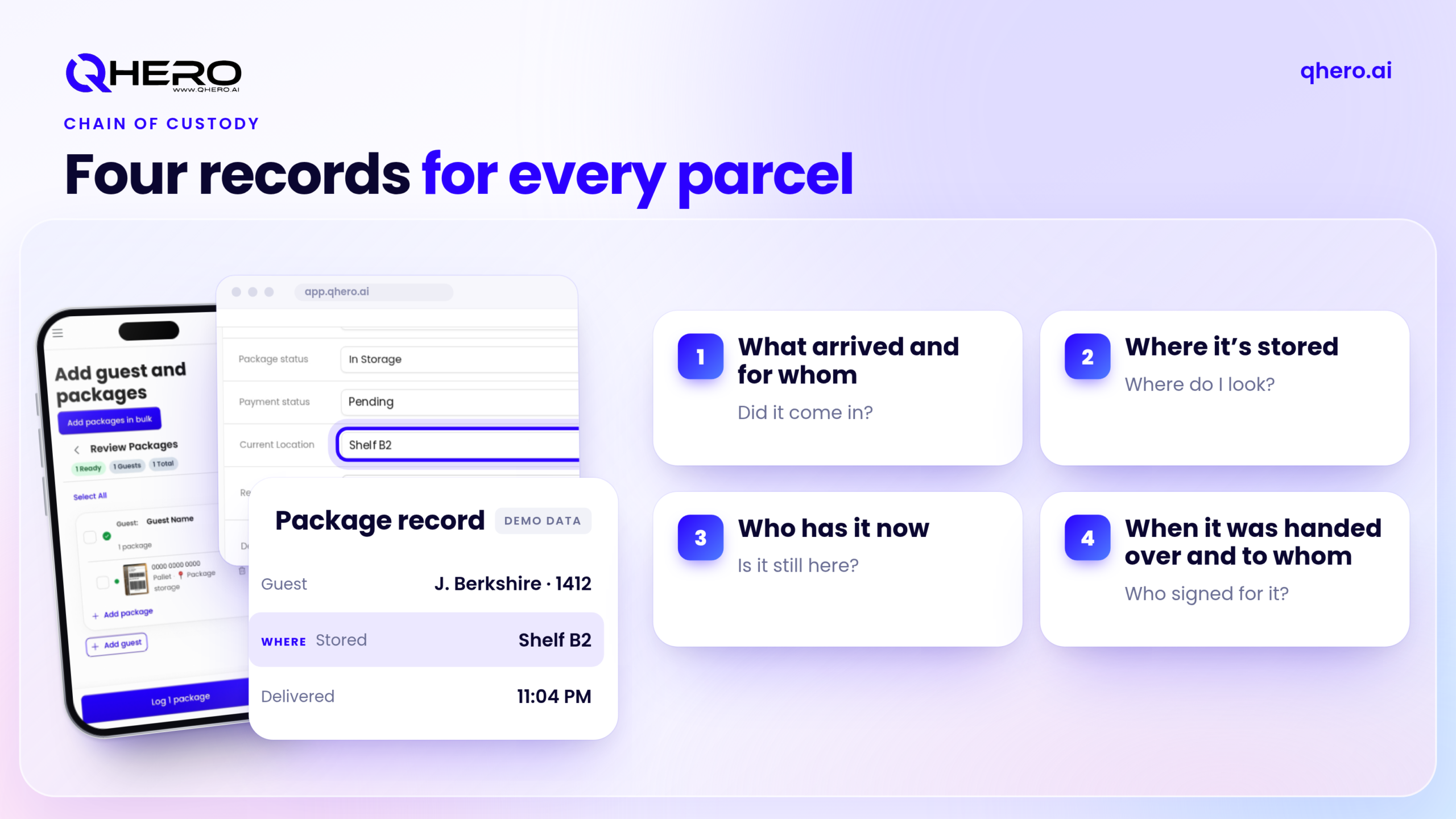
- It comes down to four records per parcel: what arrived and for whom, where it’s stored, who has it now, and when it was handed over and to whom.
- When any shift can pull those four from the log, “who signed for it?” becomes a lookup instead of a search.
In this guide, “packages” means the parcels and deliveries that arrive for guests, groups and staff, not room packages or stay bundles.
What does chain of custody mean for hotel packages?
In a hotel, chain of custody simply means you can account for a parcel at every step: received, logged, stored, moved, delivered. Each step has a time, a place and a person attached to it.
Most hotels already do part of this: someone signs the driver’s device and the box goes behind the desk. But the carrier’s record only shows the hotel received the parcel. Where it went inside the building, and who gave it to the guest, is the hotel’s record to keep.
Where do handover gaps happen between shifts?
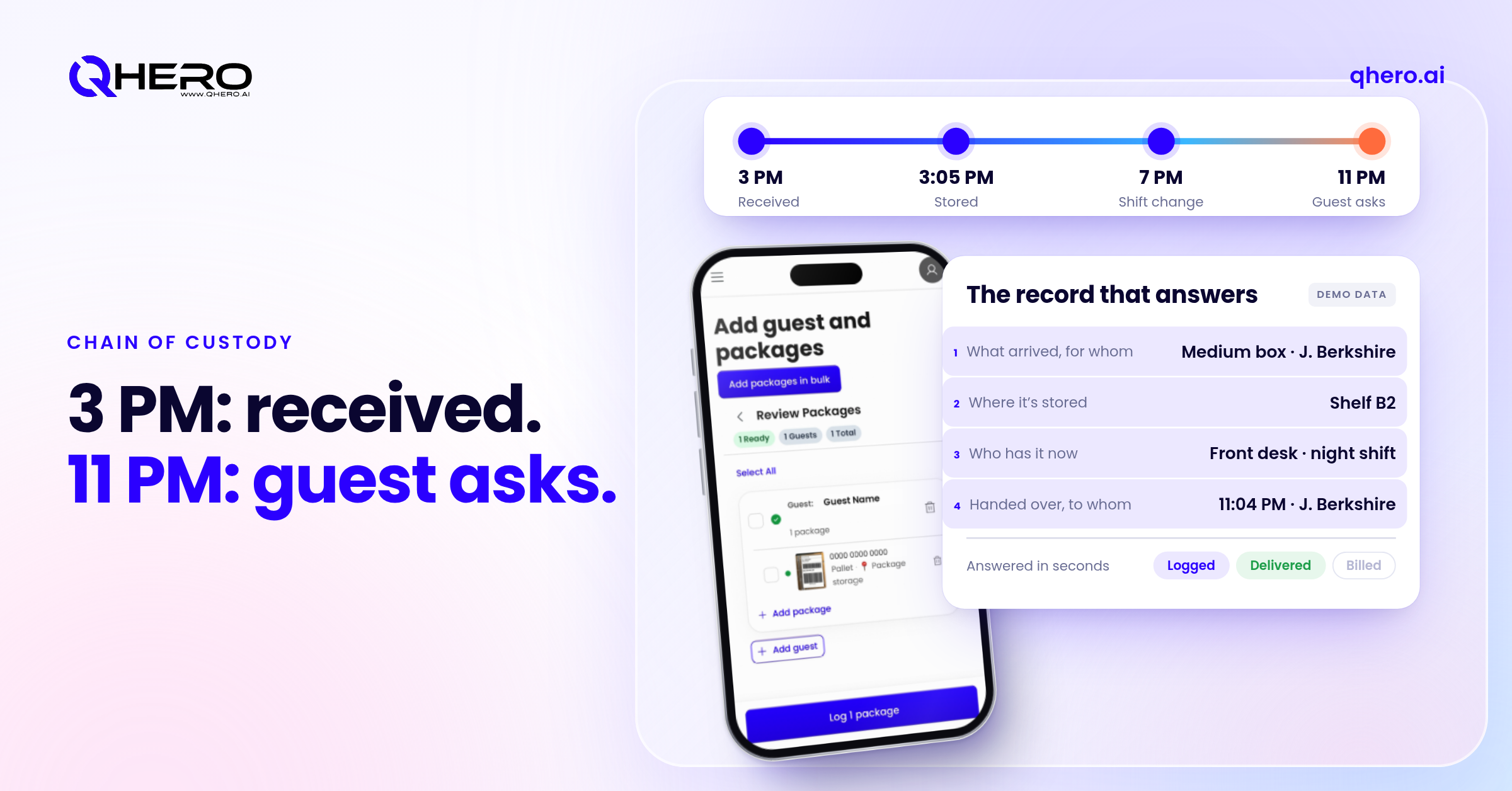
Picture a normal afternoon. The day team signs for a parcel at 3 PM and sets it behind the desk. By 11 PM, the person who took it in has gone home. What’s left is a line in the pass-on log, if someone had time to write one.
Then the guest comes down and asks for it. The night agent checks the log. Then the back office. Then the bell closet.
Nobody was careless. It’s a handover problem. What the team knew about that parcel lived in one person’s head, and the shift change is where it got lost. The usual gap points are:
- Intake during a rush. The parcel is signed for between check-ins and logged later, or not at all.
- Moves inside the building. Dock to desk, desk to back office, back office to bell closet. Each move is a chance for the record and the box to part ways.
- Shift change. Open parcels are passed on verbally, or the pass-on log has a line with no storage location.
- Delivery to someone other than the guest. A colleague, an assistant or a group organizer collects it, and nobody notes who.
Which four records answer “who signed for it?”
Each record answers a question the next shift will ask. Together they’re the chain of custody.
| Record | What to capture | The question it answers at the next shift |
|---|---|---|
| What arrived, and for whom | Carrier, tracking number, recipient (guest, group or staff), date and time received, who received it | “Did it actually come in?” |
| Where it’s stored | A storage location code (shelf, bin, cage, group area) | “Where do I look?” |
| Who has it now | In storage, with the bell desk, out for delivery, delivered | “Is it still here?” |
| When it was handed over, and to whom | Date, time, the person who collected it, the staff member who released it, and a signature if your policy calls for one | “Who signed for it?” |
What arrived, and for whom
This is the intake record. Capture it when the parcel arrives, not at the end of the shift. If staff retype tracking numbers and names by hand, this is where records get skipped during a busy check-in.
Where it’s stored
A storage location turns “somewhere in the back” into “B2.” Label every shelf, bin and cage with a short code and record it with the parcel. It’s the cheapest fix on this list.
Who has it now
This is the record most logs are missing. Parcels move: to the bell desk for a room delivery, to a meeting room for a group, to a manager’s office for safekeeping. Whoever moves a parcel updates its status, so the log shows where it is now, not where it was at 3 PM.
When it was handed over, and to whom
This closes the chain. Record the date and time, who collected it and which staff member released it. Decide your signature policy in advance (for example, always, or only for oversized or group shipments) so staff aren’t making it up at the desk.
How do you close the handover gap at shift change?
You don’t need a new form to start. You need a routine everyone follows:
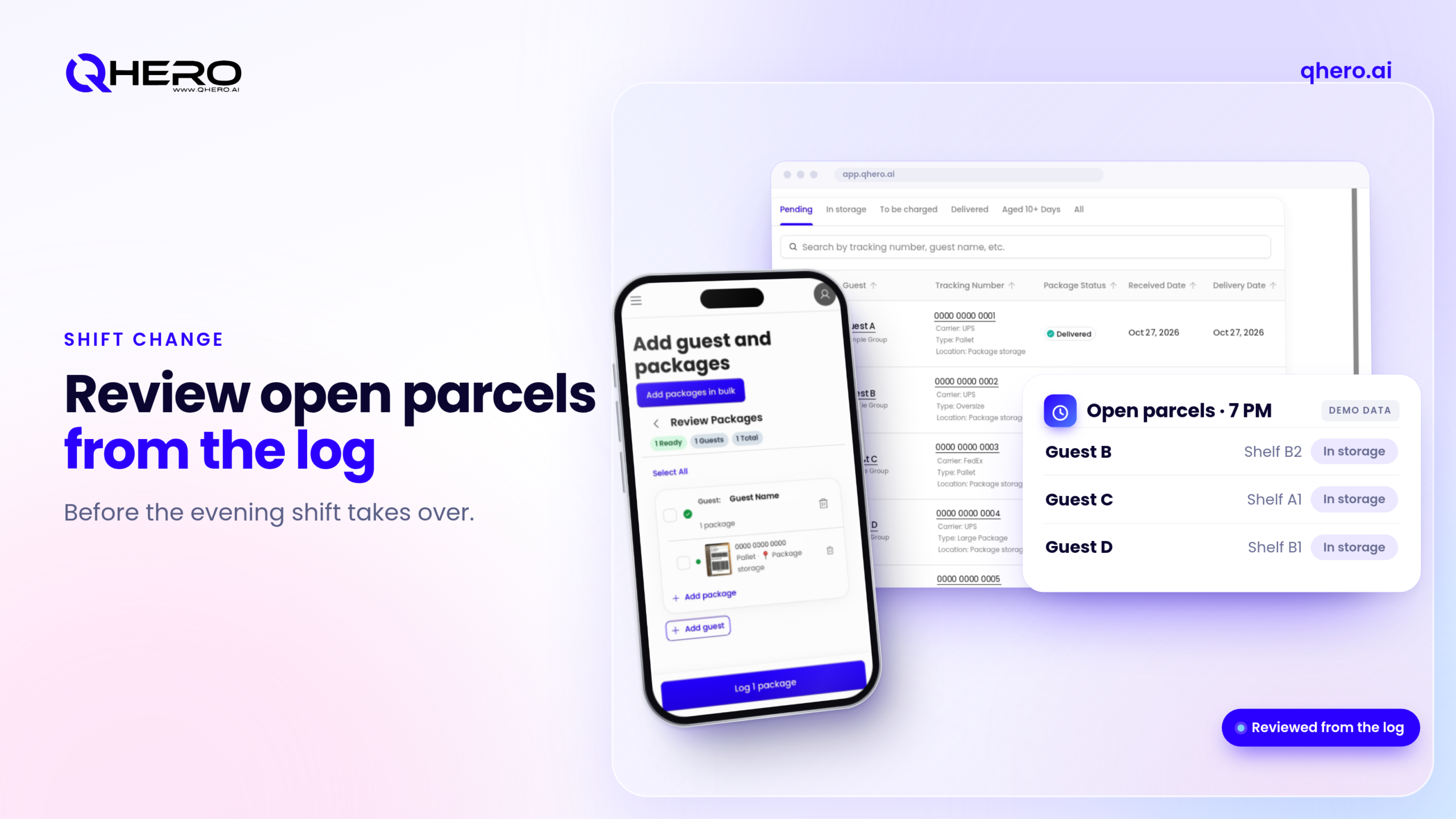
- Review open parcels from the log, not from memory. Cover anything received, moved or waiting for pickup.
- No parcel without a storage location. If a parcel in the log has no location, fix it before the shift ends.
- Every move is recorded by the person who makes it. Dock to desk, desk to bell, bell to room.
- List the exceptions. Parcels for checked-out guests, parcels with no matching reservation and parcels past your hold period go on a short list for the manager.
- One log for every door. The loading dock, front desk and bell desk all record into the same log, so there’s one place to look.
What should the record show when a guest says “I never got it”?
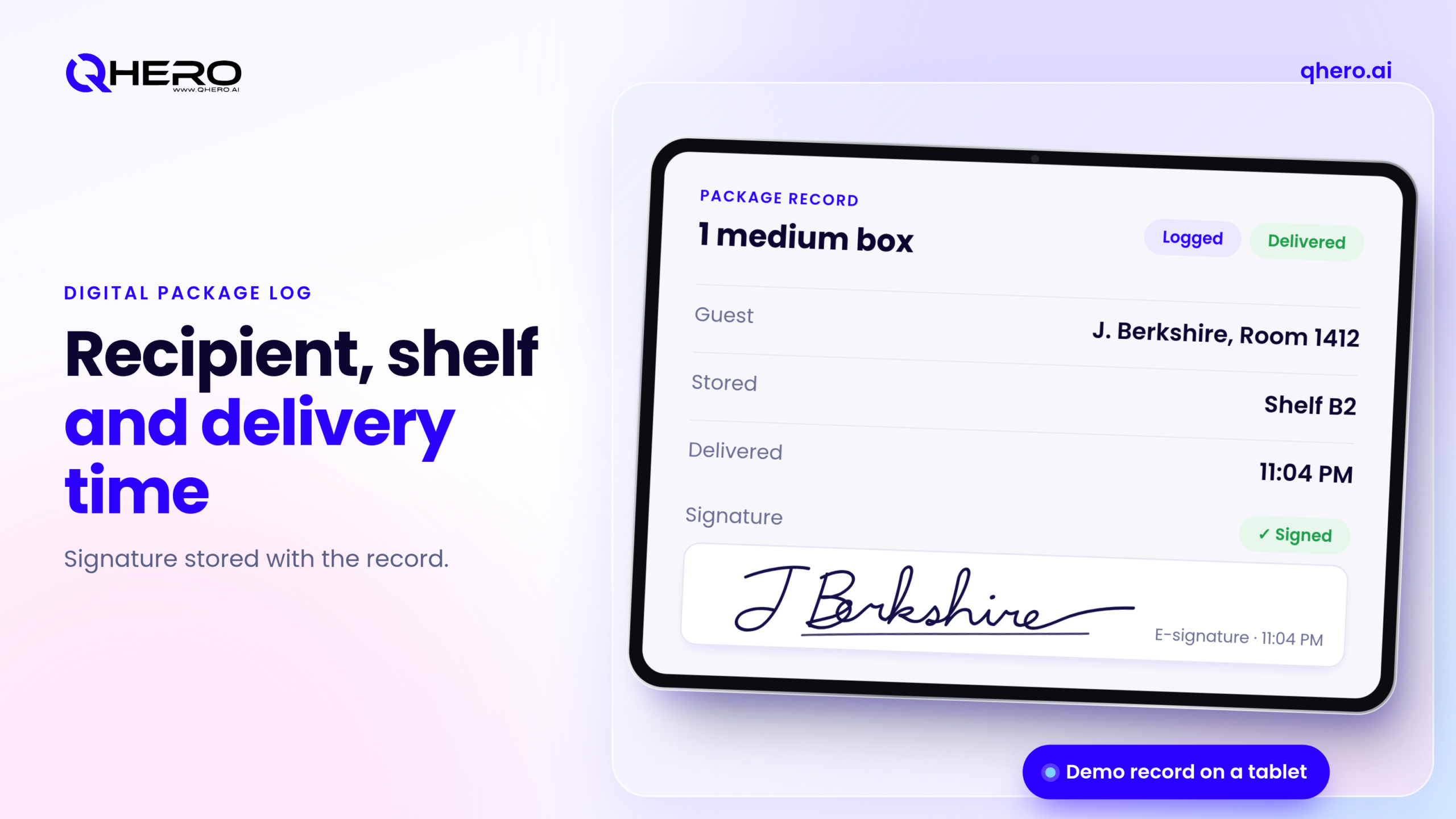
When a guest asks about a parcel, your team should be able to answer from the log in under a minute: when it arrived, where it was stored, and either where it is now or when it was delivered and to whom. If it was delivered, the record shows who collected it and which staff member released it. If it’s still in storage, you can walk to the location and get it.
That doesn’t settle every question, but it replaces “let me check with whoever was on” with facts your team can share calmly. How your hotel handles disputes, claims or compensation is a matter for your management, brand standards and counsel. This guide covers operations, not legal advice.
Paper pass-on log, spreadsheet or package log: where does each break?
| Paper pass-on log | Shared spreadsheet | Package management platform | |
|---|---|---|---|
| What arrived, for whom | Handwritten, can be illegible or skipped in a rush | Typed in; tracking numbers retyped by hand | Filled in from the label scan at intake |
| Where it’s stored | Only if someone writes it down | A column, if kept up to date | A storage location on every parcel |
| Who has it now | Rarely updated after intake | Depends on discipline | One open-package list every shift sees |
| Delivered, and to whom | Initials, if filled in | A typed name, no signature | Timestamped, with a stored signature or e-signature |
| Finding last Tuesday’s parcel | Flip back through pages | Search, if the sheet is current | Search the log |
A paper log can work well for a smaller property in a quiet week. The test isn’t the tool. It’s whether you can answer all four records for any parcel, on any shift.
A 10-minute chain of custody audit you can run this week
- Pick five parcels delivered last week, at random.
- For each one, answer the four records from the log alone, without asking anyone.
- Pick five parcels in storage right now and find each one using only the log.
- Note which record was missing most often. That’s your first fix.
- Repeat the test on a night or weekend shift.
If the audit turns up gaps, fix them before the holidays. Our 4-week holiday package surge checklist puts handover records in Week 3, alongside space, coverage and fee policy.
How QHero keeps the chain of custody in one record
QHero is the package management platform for hotels, resorts and convention properties. It keeps all four records in one package log that every shift shares, so your receiving team spends less time retyping labels and searching shelves. QHero is SOC 2 certified. It follows four steps: Scan → Logged → Delivered → Billed.
- Scan (what arrived, and for whom): staff scan the shipping label with a phone or tablet the hotel already owns, and the recipient, carrier and tracking number fill in automatically. The record is stamped with the time and the name of the staff member who received it. Damaged or perishable parcels can be flagged with a photo.
- Logged (where it’s stored, who has it now): each parcel gets a storage location, including oversize and group areas, and sits on one open-package list shared across shifts. The platform shows how long each parcel has been waiting and flags parcels nobody has claimed, so the shift change starts from the list, not from memory.
- Delivered (when it was handed over, and to whom): pickup or room delivery is recorded with a timestamp, the staff member’s name and a stored signature or e-signature.
- Billed: if your hotel charges a package handling fee, QHero posts it to the guest folio with OPERA Cloud.
Hyatt Regency Jacksonville, a 951-room hotel that receives and delivers over 50 packages a week, moved from paper records to QHero. Read the Hyatt Regency Jacksonville case study.
See how the QHero package log works.
Frequently asked questions
What is chain of custody for hotel packages?
It’s an unbroken record of every parcel and delivery from the moment it reaches the hotel to the moment it’s handed over. In practice, that’s four records per parcel: what arrived and for whom, where it’s stored, who has it now, and when it was handed over and to whom.
What should a hotel package log record for each parcel?
At minimum: carrier, tracking number and recipient; the date, time and staff member who received it; a storage location; its current status; and the date, time and person it was handed over to, with a signature if your policy requires one.
Why do packages go missing between shifts?
Because what one person knows about a parcel doesn’t reach the next shift. Verbal handovers, missing storage locations and moves that aren’t recorded are the usual causes. Reviewing open parcels from the log at every shift change closes most of the gap.
Do hotels need a signature for every package handover?
It’s a policy decision for each hotel. Some collect a signature for every handover; others only for oversized, high-value or group shipments. What matters most is that every handover records when it happened, who collected the parcel and who released it.
Is a paper pass-on log enough for chain of custody?
It can be at low volume, if it’s filled in every time. Paper tends to break down when a parcel moves, when the next shift needs to search back through pages, or when the handover is a set of initials. Test it with a five-parcel audit.
What’s the difference between hotel package tracking and chain of custody?
Hotel package tracking is the day-to-day work of logging, storing and finding parcels and deliveries. Chain of custody is the record that work leaves behind: who had each parcel, where and when, from arrival to handover.