Key takeaways
- A package handling fee is your property’s decision, and so is the amount.
- A fee holds up when it is written down, shared before the box ships and backed by a record.
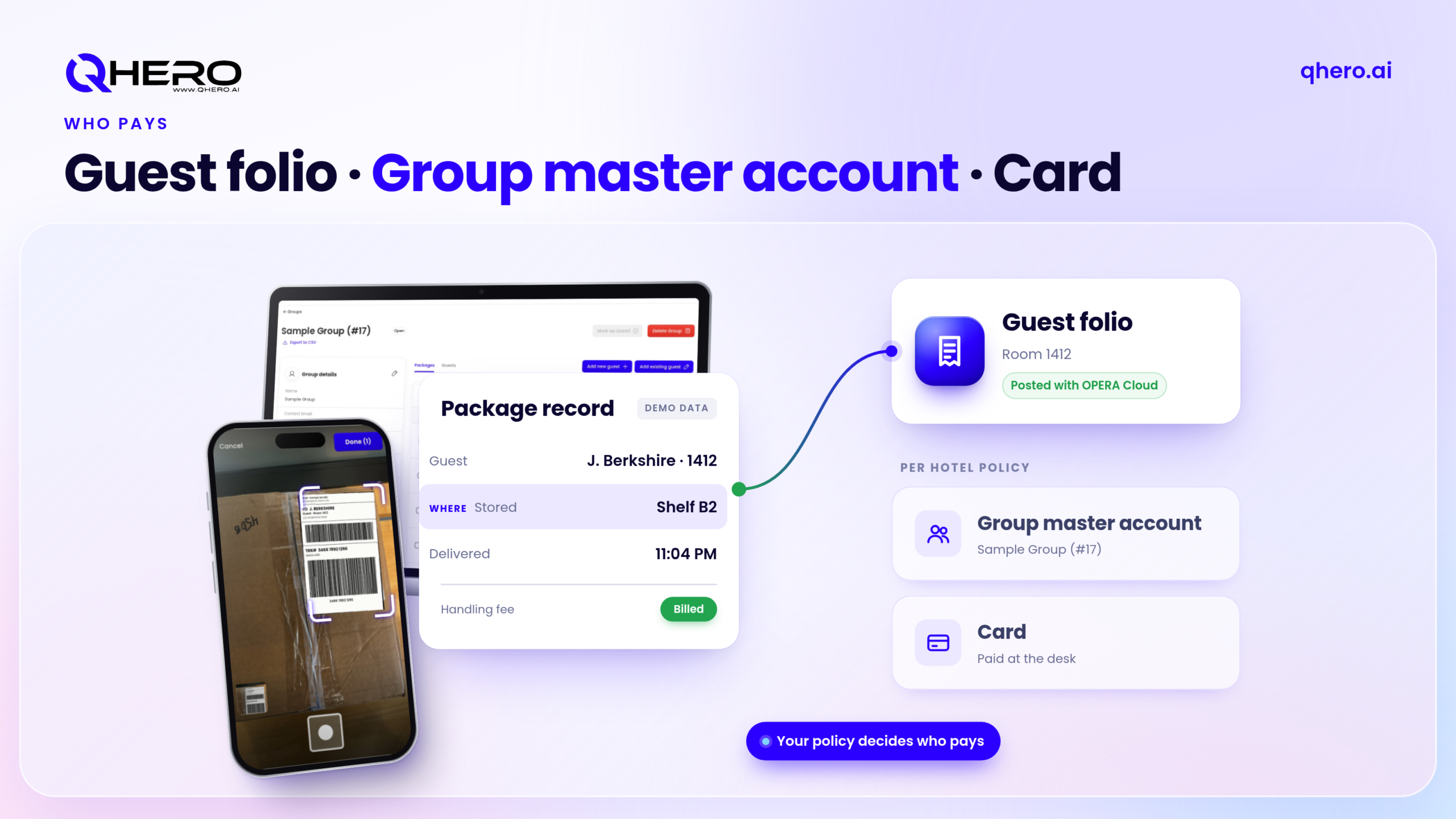
- Route every charge to the guest folio, the group master account or a card before the first box arrives.
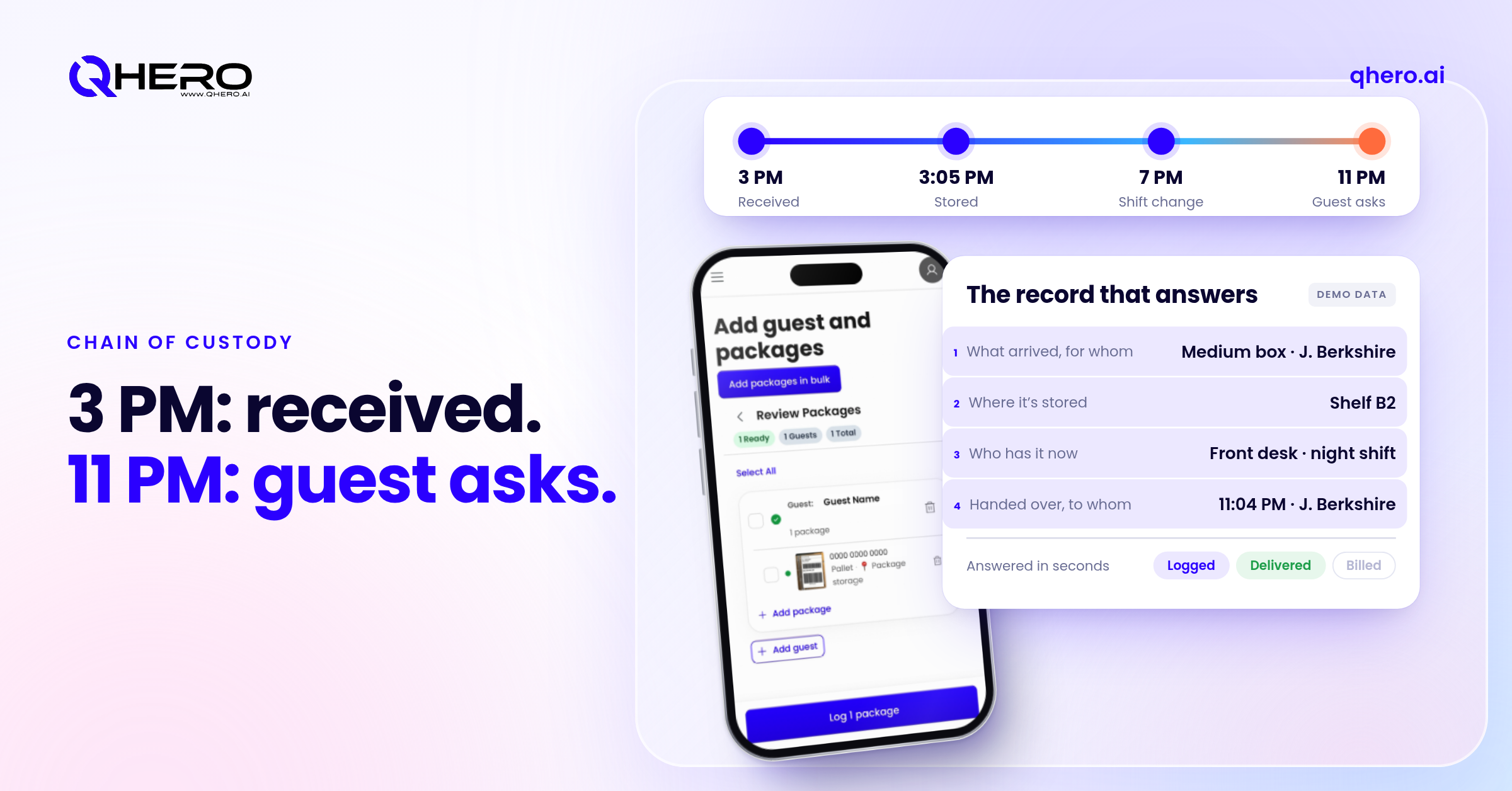
- Every charge should trace back to four steps: Scan, Logged, Delivered and Billed.
The short answer: A package handling fee is a charge your property sets for receiving, storing and delivering parcels for guests, groups and exhibitors. Whether to charge, and how much, is your decision. A fee holds up when three things are true. It is written down, it is shared before the box ships, and every charge traces back to a record showing the package was received, stored and delivered.
Setting a number is the easy part. The hard part is applying the fee the same way on every shift, and proving the work was done when a guest or a group’s finance team questions a line on the folio. This guide is for the managers who own that policy: GMs, rooms and front office managers, receiving and event services managers, and controllers.
In this guide, “packages” means parcels and freight that arrive for guests, groups and events. It does not mean room packages or stay bundles.
What a package handling fee covers
Every parcel is staff time and floor space. Someone on your team has to:
- sign for it at receiving
- log it and match it to a guest or group
- find it a storage location
- deliver it and record who received it
Large boxes, pallets and exhibitor freight add dock time, storage space and sometimes a second person.
A written fee policy can say what the charge covers: receiving, logging, storing and delivering each parcel. That list is a good test for your own policy: if your fee pays for it, your record should show it happened.
Common fee structures
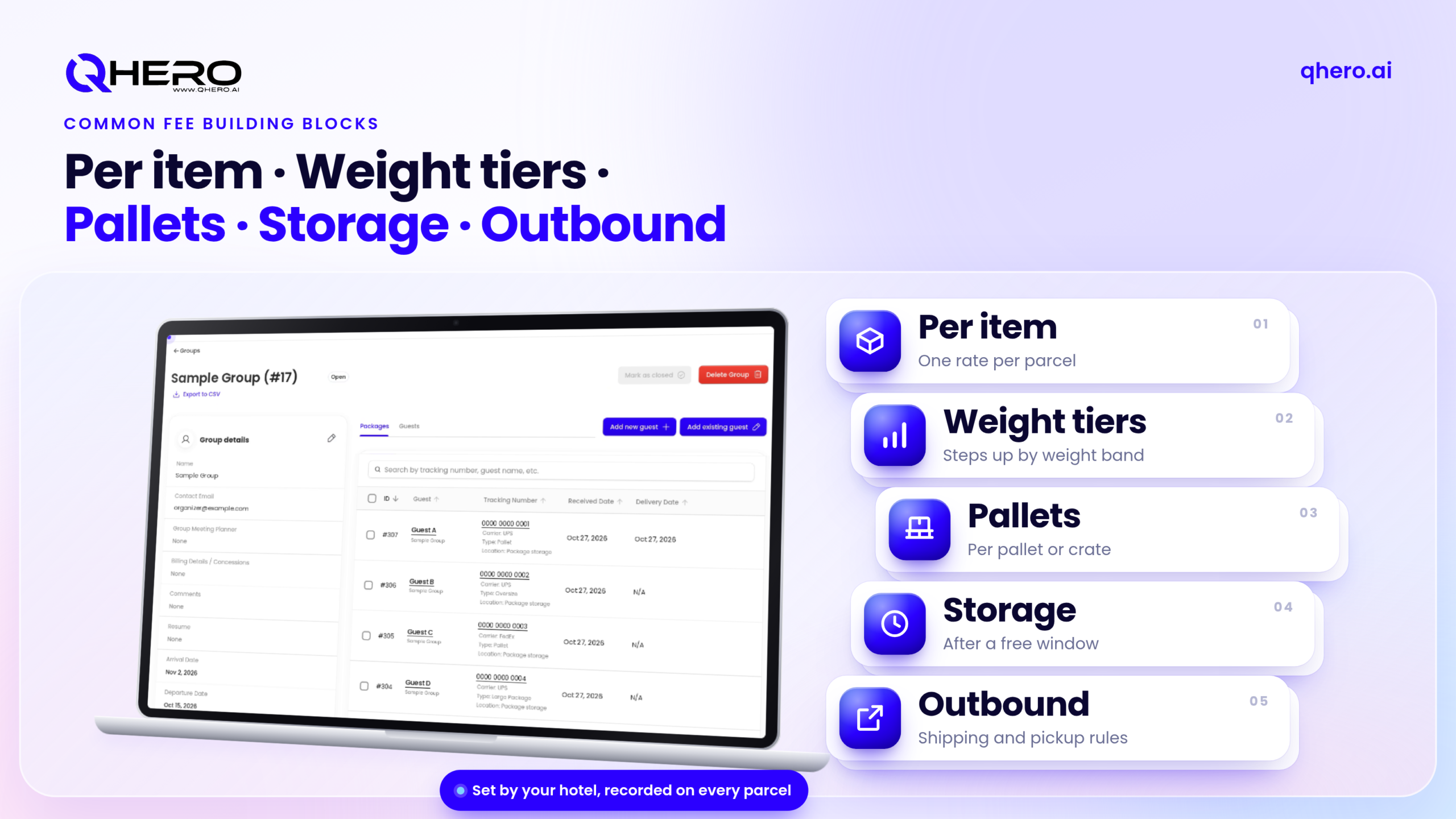
There is no single industry standard. A fee policy is usually built from a few building blocks.
Per-item flat fee
One rate per envelope or package. It’s simple for your receiving team to apply, but it can feel unfair on a small envelope.
Weight tiers
Rates step up by weight band, with envelopes, small boxes and heavy boxes charged separately. Your policy should say whether the weight comes from the carrier label or a scale at the hotel.
Pallets, crates and freight
These are charged per pallet or crate and matter most at properties that receive exhibitor freight.
Storage after a free window
A policy can charge storage for items that arrive well before an event or are held past a set period.
Outbound handling
A fee policy can also cover outbound shipping and carrier pickup cutoffs, or simply state the rules.
We don’t recommend a fee amount. What to charge should come from your own costs, your market and your brand standards, reviewed by finance.
Who pays: guest folio, group master account or card
Write routing rules for each type of recipient before the first box arrives.
- In-house guest: post to the guest folio.
- Arriving guest: hold the package and attach it to the reservation, then post at delivery.
- Group attendee or exhibitor who is not staying: post to the group master account or a card on file, per the group contract.
- Departed guest: follow your written policy for holding, returning or charging a card.
Whichever routing you choose, write it into the fee policy itself so the desk doesn’t decide case by case.
Where unbilled packages come from: a box arrives with a name that doesn’t match a reservation. It gets set aside to sort out later, the guest picks it up during a rush, and nobody posts the charge. If the record can’t match a package to a folio or a group account at receiving, the fee usually doesn’t get posted.
How to disclose your fee before the box arrives
Guests push back hardest on fees they learn about at checkout. Public guest threads about package fees mostly describe surprise, not the amount. Put your policy wherever people look before they ship:
- Your website: on the page or FAQ with the hotel’s shipping address and labeling instructions
- Confirmation and pre-arrival emails: a short line with a link to the policy
- Group contracts and BEOs: which shipments post to the master account, and the early-arrival window
- Exhibitor kits: labeling requirements, rates by type and storage rules
- At arrival: a one-page written policy the team on shift can point to
Use one policy document across sales, events, finance and receiving. If the group contract says one thing and the desk says another, expect a dispute.
A note on rules. The FTC’s Rule on Unfair or Deceptive Fees (16 CFR Part 464) took effect May 12, 2025. It covers short-term lodging and addresses how the total amount and fees are disclosed and described (FTC guidance). State rules may also apply. How any of this affects a package fee is a question for your counsel. This article is not legal advice.
Why fees get waived or disputed (and how to stop it)
Most waived or disputed package charges come back to the same gaps:
- No receipt record. A guest says the package never came, and the log has initials or nothing.
- No timestamp. Nobody can say when it arrived or how long it was stored.
- No proof of delivery. There’s no record of who released it, to whom or when.
- Inconsistent staff. Day shift charges by type, nights charge one rate, and weekends don’t charge.
- Late posting. Charges are reconciled after checkout, when they are hardest to explain.
A property that can’t prove receipt can’t defend the charge. The fix is a record that’s built at receiving, not reconstructed later.
The record behind every charge
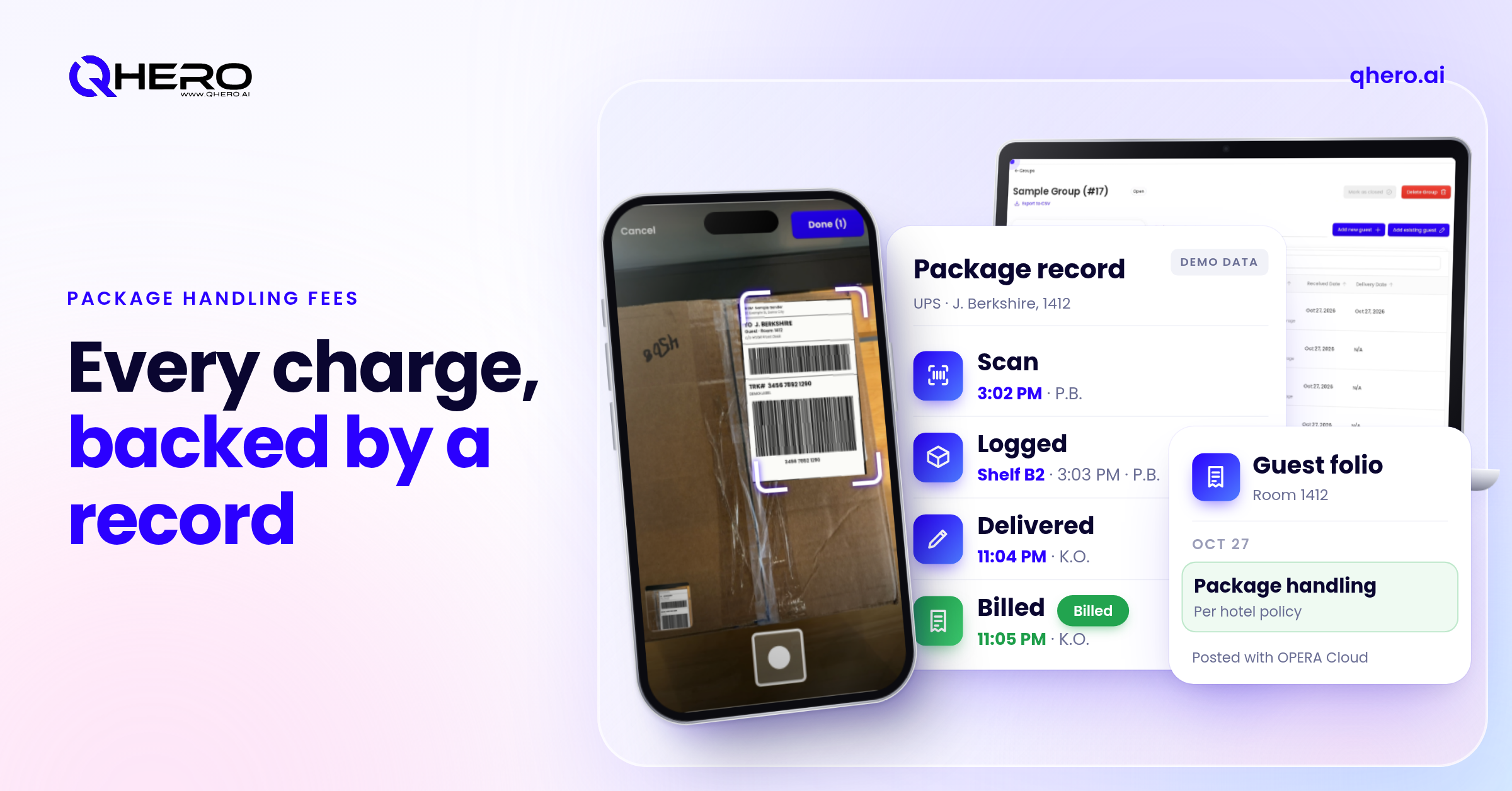
Every charge should trace back to four steps, each with a time and a staff name attached. These are the same steps the QHero platform follows.
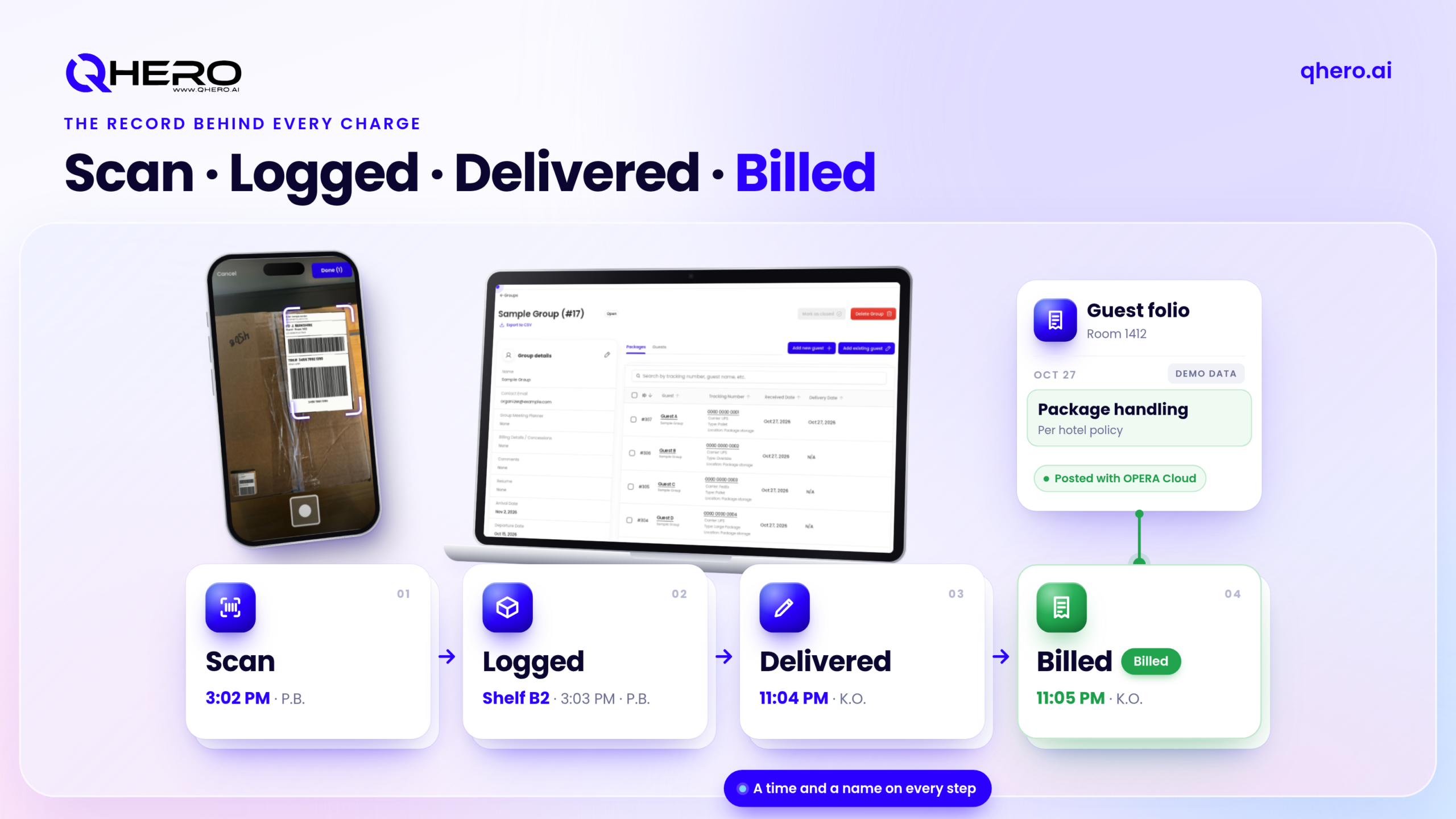
Scan
Whoever receives the package scans the label. On the QHero platform, the label scan fills in the recipient, carrier and tracking number, and records the time and the staff member who received it.
Logged
The package goes to a storage location, including oversize and group locations, and that location is recorded. Every shift sees the same open-package list, so nobody rebuilds the count from a notebook at shift handover. Damaged or perishable packages can be flagged with a photo.
Delivered
The release is recorded with the time and the staff member, and a signature or e-signature is stored with the record. A signature is recommended for every release, and always for high-value or ID-required items. This is the step most disputes turn on. For more on proof at this step, see how to reduce package theft and misdelivery.
Billed
The fee follows your written policy. With OPERA Cloud, the QHero platform posts the package fee to the guest folio (features). If the record is incomplete, fix it or waive the charge. Billing only what you can show was received and delivered keeps the policy credible.
Results at two properties. These are individual results, not typical or guaranteed ones. Hyatt Regency Portland’s case study reports “a 572% increase in package handling revenue” that “was achieved in just one month,” with the hotel comparing “January’s numbers so far” with January 2025 (Hyatt Regency Portland case study). Hyatt Regency Jacksonville’s case study says “QHero saves staff 2 hours daily” (Hyatt Regency Jacksonville case study).
See how a package goes from Scan to Billed on your own workflow, with less work for your staff. Book a walkthrough.
Setting your policy: a 6-point checklist
- Free threshold: decide whether anything is free, for example envelopes or a first item.
- Tiers: use few enough rates that the team on shift can apply them without calling a manager.
- Storage window: set how many days before arrival or an event you accept packages without a storage charge.
- Group vs. individual: decide which shipments post to the master account and which go to the guest folio.
- Waiver authority: name who can waive or adjust a charge, and require a written reason.
- Unclaimed and return rule: set how long you hold a package, when it moves to lost and found, and when it is returned to sender.
During peak periods, review the previous day’s delivered packages against posted charges every day.
Frequently asked questions
How much should a hotel charge for package handling?
There is no industry standard, and we don’t recommend an amount. Base the rate on your own costs, your market and your brand standards, and have finance review it. A fee policy can combine per-item rates, weight tiers, pallet charges and storage charges.
Can a hotel post a package fee to the guest folio or a group master account?
Yes, if the property’s policy says so. A policy can route charges to the guest’s room folio, the group master account or a credit card, depending on who the recipient is.
How should a conference hotel charge exhibitors for shipping and receiving?
Set the rates out in the exhibitor kit or group contract. Charges can be per box or per pallet, sometimes with storage fees for early arrivals, and are posted to the group master account or the exhibitor’s card.